Outsourced Execution: Should You Do It Yourself?
Running an execution desk can cost £1.5m per year for a 3-person team. For smaller hedge funds and family offices, that can be a prohibitive cost. We explore the outsourced execution landscape and how asset managers can benefit from delegating flow to third-party providers.
By The Good Guys Company
Christian Cebreros, Managing Partner at The Good Guys Company, explores the Outsourced Execution industry and market to help Asset and Wealth Managers understand the value of this external capability to their business and how to navigate the landscape of providers.
Introduction
The key differentiating activity of Asset Managers is their product offering and investment process. Once portfolio managers have decided in which instruments to invest, someone has to go to the market, assess which execution strategy is beneficial and buy that instrument at the best possible conditions. Enter the role of the execution desk.
Considering that running such a desk can cost £1.5m per year for a 3-person team (incl. comp, tech, terminals, data feeds, storage), it would cost the Asset Manager 10bps if he manages £1.5bn in assets. For smaller hedge funds and family offices, 10bps can be a prohibitive cost of execution.
And a 3-person desk very rarely has a multi-asset class capability and/or does it cover all time-zones.
Larger Asset Managers might be in the position to afford their own execution desk, but their desk may still not be large enough to compete with the execution capability (in terms of liquidity access, negotiation power, execution quality) of large asset managers or even outsourced execution providers. It could also be that their execution desk is not providing a clear contribution to performance or the Asset Manager's value proposition.
Should You Do It Yourself?
To answer this concretely, you have to answer the following questions:
- Is your execution desk delivering alpha consistently for your products (and is that alpha obvious to the organisation)?
- Is your execution desk creating added value that enables a unique product offering/supports your value proposition?
- Is your AuM significant enough to justify the cost impact of running your own execution capability?
If the answers aren't obvious to you then you might benefit from outsourcing your execution capability.
If you cannot explain, and the organisation and its clients do not understand the current and future overall value of the internal execution capability, why should the company allocate resources to it? It will cost the company a great amount of resources to establish, run, and develop the execution capability to stay at least on par with the market.
Outsourcing Models
How exactly can Asset Managers benefit from delegating flow to third-party providers? These providers typically offer three models:
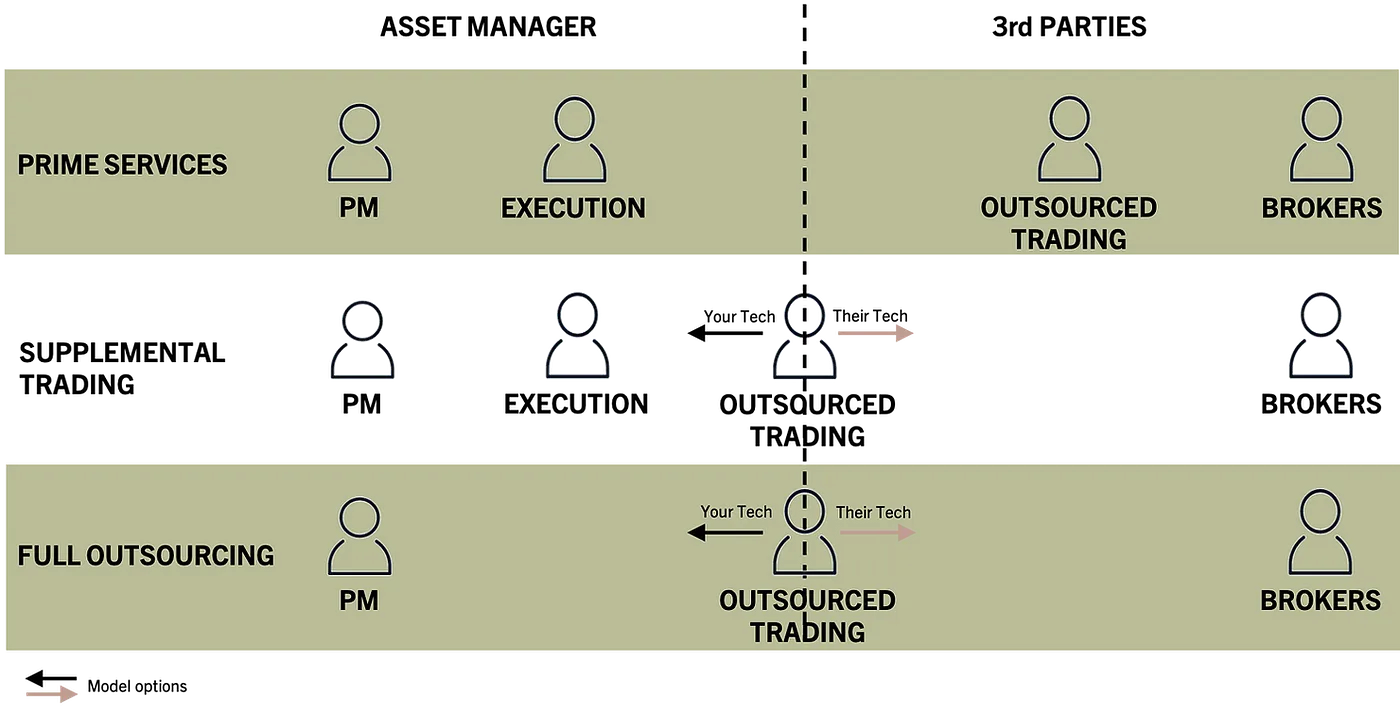
- Prime Services: You use the providers as brokers, leverage their market access, their broker network and expertise, asset class and time zone coverage, and they provide you anonymity since they face the street. Settlement is with the outsourced execution provider.
- Supplemental Trading: You cover what provides added value to you and your clients in terms of asset class and/or regional expertise and supplement it with a third-party provider to enhance your asset class, time zone coverage, broker network and liquidity access, and market specific expertise at lower risk. This also strengthens your business continuity plans and reduces costs in areas where you don't provide significant added value. This can be done with the third-party team at the provider's locations or on client premise.
- Fully Outsourced Trading: The provider typically uses his own technology, people, and processes, and investment managers connect via standard interfaces. This service would also typically include research, market color, execution quality analytics.
Common Concerns Addressed
How are conflicts of interest managed? Outsourcing providers know this is a sensitive topic. Their models are agency only, when belonging to a sell-side company they enforce strict Chinese-walls, and they offer toxicity analysis to prove low to no levels of information leakage.
What happens in a big market correction? This depends on the model you choose. If you have a dedicated desk assigned to you, then there is no difference to an internal desk. If you don't have a dedicated desk then it will be first-in, first-out.
Does the outsourcing provider accept fiduciary responsibility? The fiduciary responsibility remains with the Asset Manager. Nevertheless it is key to have governance processes to help enforce and hold the outsourcing provider accountable for delivering best execution.
Factors to Compare Providers
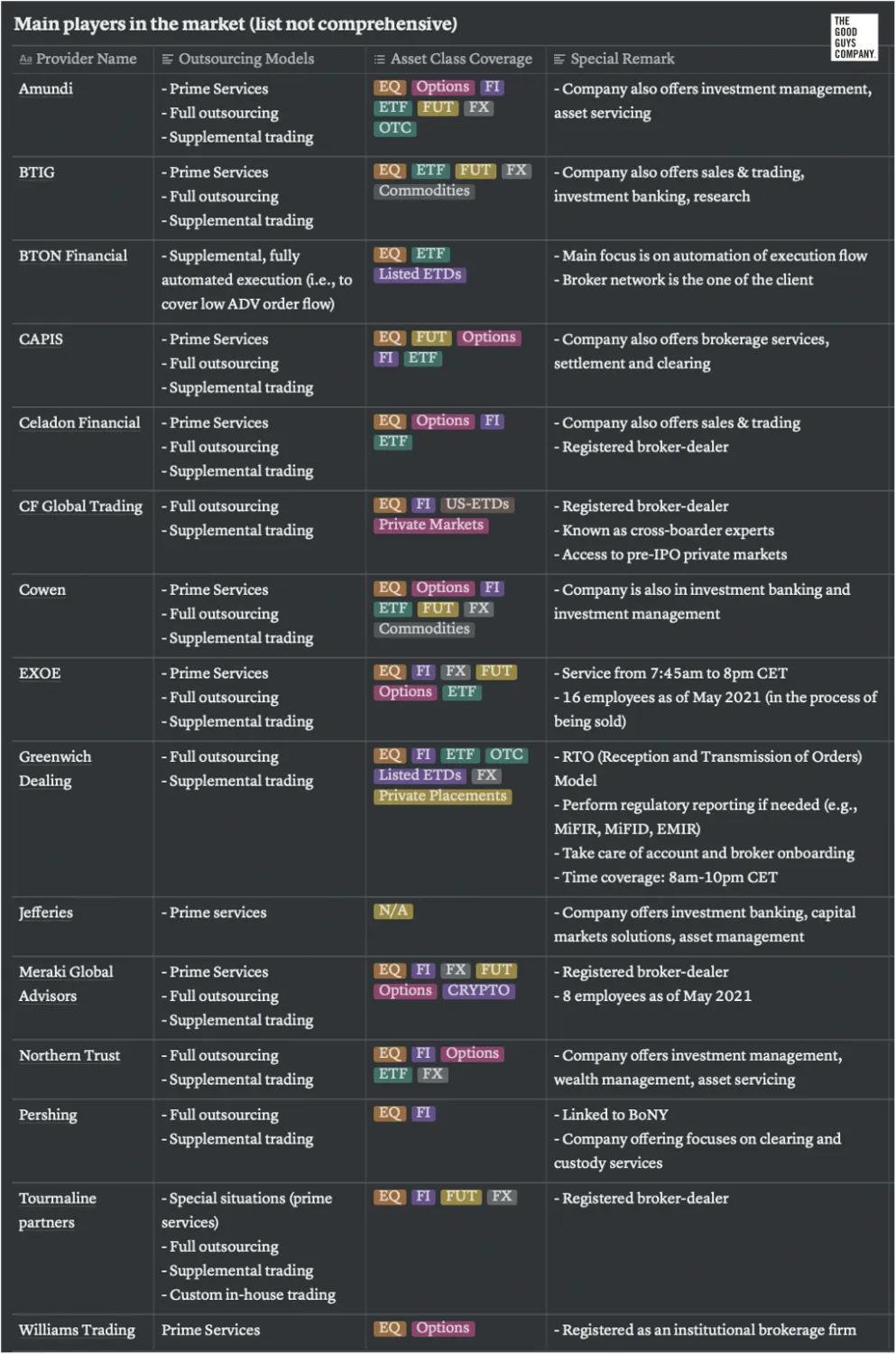
When evaluating outsourcing providers, consider: cost, service level, experience, liability, risk and quality of execution, depth of integration with portfolio managers, and depth of integration with your middle office.
We recommend starting with the providers' high-level offering to accelerate the screening process.
Benefits of Outsourcing
- Leverage the economies of scale to access liquidity on the street
- Anonymity to the street
- Higher, inherited market power
- Cost flexibility / ability to charge the fund
- Time-to-market when expanding regional, timezone, asset class coverage
- Overflow service when the internal desk has too many orders to manage
- Reduction of regulatory burden and adaptation cost
Potential Caveats
- Losing market insights depending on the chosen model, especially in emerging markets
- Little evidence on how the relationship would develop in times of market stress
- The responsibility for Best Execution is still with the Asset Manager
- If the business grows and the execution capability is to be in-sourced, the Asset Manager might not get the historical data with the required level of granularity
- Unclear effectivity of IPO/New Issue liquidity access
Conclusion
If the positive contribution of the Asset Manager's execution capability is not immediately clear, it may be worthwhile to consider testing an outsourcing provider to complement the in-house execution desk. So far, most Asset Managers are opting for supplemental trading and not for full outsourcing. If your in-house desk is a strategic capability because it allows a unique product offering or delivers superior performance enhancement, then outsourcing your execution would be a business continuity solution at best.
The TGGC Outlook
We believe that outsourced execution providers will consolidate in the coming years, resulting in large, very professional execution agents who will make it more and more difficult to justify running your own execution desk. They will cover processes linked to execution — trade processing, securities operations, collateral management, repo, trade surveillance, regulatory reporting — and will be able to provide deep data analytics and very high levels of automation.