AI in Private Markets | Considerations for Small- and Mid-Sized Managers
Profitability in Traditional Asset Management has declined, leading to a greater focus on Private Markets and intensified competition. This white paper explores how small- and mid-sized managers can leverage AI to enhance efficiency and gain a competitive edge.
By Mads Døssing, Platform Strategist at The Good Guys Company
Executive Summary
Profitability in Traditional Asset Management has declined, leading to a greater focus on Private Markets, which has led to intensified competition in a fundraising environment that is currently under stress from macroeconomic headwinds. So far, the bigger managers have been able to continue their growth, but the small- and mid-sized firms have begun to face challenges. This white paper explores how these managers can leverage artificial intelligence (AI) to enhance efficiency and gain a competitive edge.
The application of AI can help all types of Private Market Asset Managers. However, this paper focuses on the application for small and mid-sized firms as these are believed to be able to benefit the most by limiting the resource and scale gap they currently face compared to the bigger firms.
This white paper will highlight areas AI can help limit this gap and increase competitiveness of small- and mid-sized managers, particularly:
- Fundraising can benefit from AI by optimizing communication through detailed meeting preparation and actionable follow-ups, fostering more meaningful relationships.
- AI offers the potential to increase the efficiency of RFP and RFI processes, leading to a first draft substantially faster than what is currently possible.
- In research, AI can accelerate the analysis of both quantitative and qualitative data, facilitating more informed decision-making and improving the creation of compelling narratives for investors.
- AI can streamline the investment process by automating deal pre-screening, data extraction from virtual data rooms (VDRs), and the creation of investment committee (IC) memos, ultimately speeding up transaction execution.
Increased Competition in an Already Stressed Fundraising Environment
From 2007 until 2022, profitability in traditional asset management halved from 15 bps to approximately 8 bps. This decreased profitability of traditional assets over the last two decades has led to an increased focus on Private Markets as a way for asset managers to rejuvenate their revenue side. However, this move by traditional asset managers has led to a substantial increase in competition as both alternative and traditional managers conglomerate in the Private Markets space.
This increased competition comes at a time when the global fundraising environment is increasingly tough. Higher interest rates and economic uncertainty has driven an increased spread between buyers and sellers in the Private Market space, leading to a tougher exit environment where managers can choose to either hold their positions or exit at the cost of returns.
2024 marked the third consecutive year where capital raised as well as the number of fund closings decreased. During these years, the larger firms have managed to maintain momentum in fundraising while small- and mid-sized firms have been struggling.
The outlook going into 2025 was originally expected to be an easing up of the exit environment, which in turn could stimulate the fundraising environment, but so far this has not materialized due to geopolitical uncertainty. This means managers need to themselves find a way to entrench their market positions and position themselves for growth.
From what we have seen working with actors in the industry, the increased competition in the Private Markets space will lead to the long-term winners going in one of two directions:
- Build a specialized alpha-generating firm that focuses on a single asset class (e.g. Private Debt) and build out a strong offering in this space with a tailored operating model.
- Build a scale platform that can diversify across Private Markets (e.g. Private Equity, Real Estate, Private Debt etc.) and build out an operating model that can adjust and adapt to increasing complexity and different requirements.
The Simplified Core of Private Markets
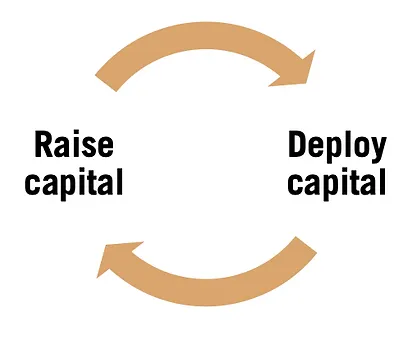
As the fundraising environment continues to be under pressure from macroeconomic headwinds and geopolitical uncertainties, Private Market managers need to increase their strength in core business functions (raising and deploying capital).
In a simplified manner, one can say that by increasing the ability to consistently raise capital and deploy raised capital, a manager can grow their existing funds while maintaining the fund's top performance. Thereby, strengthening these parts of the business is a priority, no matter if you seek to build a specialized alpha-generating firm or a scale platform.
Raising Capital: Fundraising
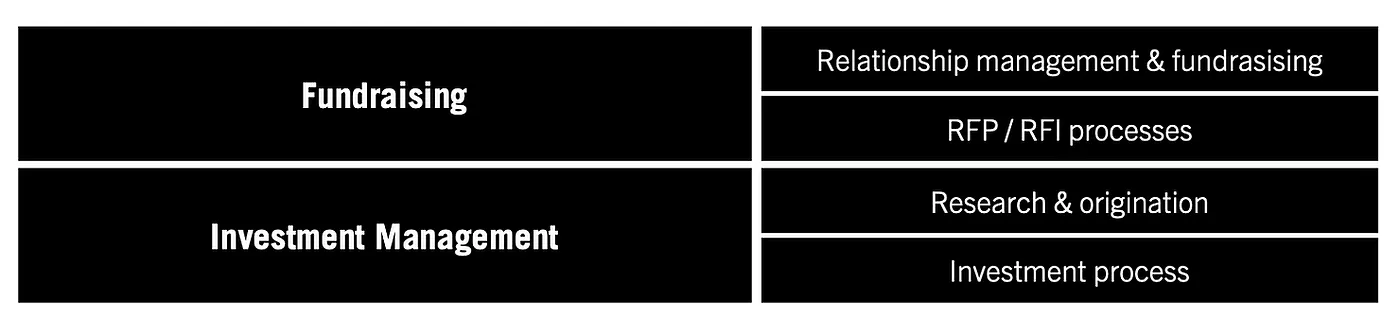
Raising capital for new vintages of fund families as well as initiating new mandates can be conglomerated under the umbrella of the fundraising function. In the fundraising universe managers can choose to prioritize different types of Limited Partners (LPs) such as institutional clients (e.g. pension funds and sophisticated single-family offices), where issuances of RFPs and RFIs are common practice, or private wealth clients (e.g. multi-family offices and UHNW), which tend to be more relationship-driven. Strengthening your fundraising capabilities can be done either by hiring additional staff or augmenting the existing staff with tools to make their work more efficient and higher quality.
Deploying Capital: Investment Management
Deploying capital for both funds and mandates can be conglomerated under the umbrella of the investment management function. The investment management function covers research, origination as well as due diligence, execution and monitoring of investments. A key part of building a scalable Private Markets manager is ensuring you have strong origination capabilities (extensive pipeline of top opportunities) as well as the transaction engine to execute on the opportunities in a timely manner.
You can build a strong origination network by hiring senior professionals and a strong transaction engine either by having a substantial bench of more junior staff or augmenting existing staff with tools to make their work more efficient and higher quality.
The Need for Efficiency in Core Business Functions
Based on the high-level descriptions in the previous sections, it is possible to separate the fundraising and investment management functions into a total of 4 capability focus areas. Shared among these areas is the need to process large amounts of historical data, whether it be previous meeting notes, previous RFP/RFI responses as well as internal unstructured data, quantitative and qualitative research data or unstructured data from a Virtual Data Room (VDR).
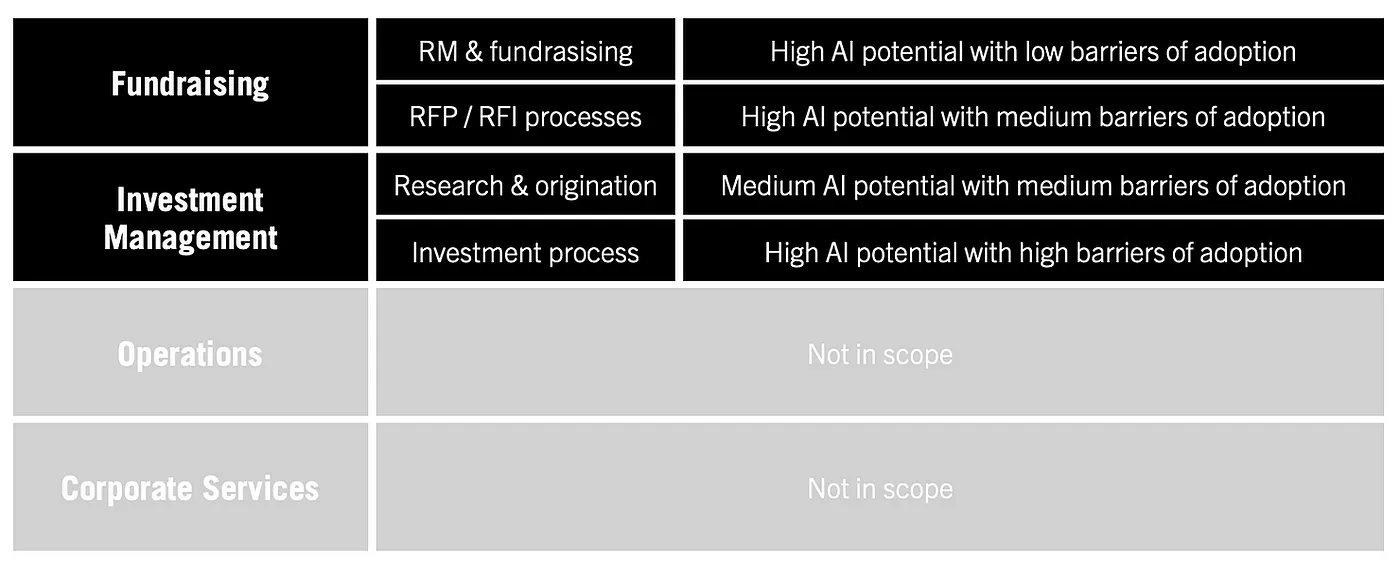
When looking at fundraising and investment management functions, based on our discussions with managers and emerging as well as leading service and tech providers, we have highlighted the AI potential as well as the barriers of adoption for each area.
This is where Artificial Intelligence (AI) comes into play. The concept of AI is not a new invention. It has however, seen new business applications emerge after the emergence of Large Language Models (LLMs) and more recently, AI agents and Retrieval-Augmented Generation (RAG).
The ability to process and interact with large swathes of both quantitative and qualitative data creates the opportunity to augment existing human teams with a data analysis engine that improves continuously. This presents an interesting opportunity for Private Market managers, who operate in a space where human employees are expensive to employ and you want to extract the maximum amount of value from each employee.
The application of AI can help all types of Private Market Asset Managers. However, this paper focuses on the application for small and mid-sized firms as these are believed to be able to benefit the most due to the resource and scale gap they currently have compared to the bigger firms and the ability for AI to reduce this resource and scale gap.
Example AI Use Cases: Relationship Management & Fundraising
Relationship management and fundraising in Asset Management in general, but especially in Alternative Investments, is a constant roadshow game, where business development and senior investment professionals are almost constantly on the road visiting prospects and maintaining relations to existing LPs.
CRM systems have existed for a long time and today it is normal for fundraisers to have constant access to their CRM on both their laptop and smartphone. However, with the constant meetings with different people as well as the many different emails that are sent out on a daily basis, it can be difficult to stay on top of it all and not mix different interactions together. This is an interesting use case for AI to assist fundraisers in preparing for meetings by analyzing previous touchpoints as well as draft emails. Many CRM systems have begun to roll out AI agents that function almost as a personal assistant to the fundraisers, which is a promising way of providing high-touch solutions to LPs in an efficient and more scalable way than previously thought possible.
The benefits here are focused on enabling stronger relationships and better business outcomes as fundraisers would be better prepared for meetings and would have more accurate responses with faster response times leading to more effective and efficient building of relationships.
Example AI Use Cases: RFP & RFI Processes
Especially asset managers dealing with a more institutional LP segment will understand the pain of RFIs and RFPs in today's market environment. The tricky part about institutional RFIs and RFPs is that they vary substantially in content asks from institution to institution (even though many questions will be repeats). This also means automating workflows previously have been a challenge for managers.
The writing up of Due Diligence Questionnaires (DDQs) as well as the substantial amount of data that has to be gathered from all parts of the business to respond to an RFP is a herculean task for many managers.
Additionally, this area is an often-ignored use case compared to the more "attractive" AI topics like deal screening and financial modelling automation. However, this is one of the topics where substantial human resources could be freed up across the entire organization (front-to-back) by implementing AI solutions to efficiently gather inputs and prepare initial draft response packs to RFIs and RFPs.
AI can significantly reduce the time it takes to send a first draft of an RFP/RFI response for internal review. This solves the initial hurdle of gathering data as well as overcoming the "blank page" or copy-pasting from previous responses.
Example AI Use Cases: Research & Origination
Research is a core part of the Private Markets business. Not only is it used for commercial due diligence purposes, but it is also used as a powerful marketing tool and as a way to stay relevant in an increasingly content-driven world, where managers constantly compete for the eyeballs and attention of LPs.
The entire research process is built around analyzing large amounts of both quantitative and qualitative data such as traditional and alternative market data, news articles etc. Today, these workflows are usually handled by human employees who perform the analysis (sometimes augmented with statistical tools and code scripts) and draft the research papers.
AI solutions today can be used to increase the efficiency of the data gathering and analysis work compared to historical solutions like Python scripts, VBA macros, and close study of white papers and articles. We are not talking about replacing employees but making the employees more efficient and increasing actionable output.
AI can be used to drive higher quality commercial due diligence as well as thought leadership due to the increased quantity of both quantitative and qualitative data that can be processed. This can in turn lead to either better decision making when pursuing investment opportunities as well as create more engaging content for LPs.
Example AI Use Cases: Investment Process
The Private Market investment process is dependent on a pre-screening process based on a number of high-level investment criteria. Any opportunity that passes this initial screening is usually funnelled into a due diligence phase, which relies on substantial amounts of human effort as junior staff will fetch and structure data from the VDR and plug it into their financial model templates to calculate the attractiveness of said opportunity. If an opportunity shows promise, it might be shown at the investment committee meetings multiple times. Each time requires a memo to be drafted, another human-driven process.
Today, these processes from screening to IC are largely dependent on deal team members pulling long hours to perform manual workflows that in themselves do not add much value. And in certain cases (like an opportunity with a short transaction window), the ways of working today forces employees to "burn midnight oil" as a way of getting the job done. Not because of the value-add but because of the lack of proper tools to execute on transactions fast.
In the increasingly competitive Private Market industry, having an efficient transaction engine is key, and to achieve this, multiple buy-side houses are already exploring AI technologies to augment their teams and sometimes even automate certain workflows in the investment process. Everything from automatic pre-screening of deals to fetching and structuring data from VDRs to drafting of IC memos, the applications for AI in the investment process are many. This is one of the concrete opportunities for small and mid-sized firms to close the efficiency gap to the larger managers.
AI can significantly reduce the effort of deal team members across the entire investment lifecycle from pre-screening to VDR data extraction to due diligence and IC approval. The efficiency gain can be used to scale the transaction engine and in turn enable the raising of bigger funds while retaining key talent.
Looking Ahead
If you are interested in learning more about how to define a long-term strategy, future-proof your operating model or implement AI tools into existing use cases, reach out to us at The Good Guys Company (TGGC). We provide you with independent, hands-on buy-side experience as well as exposure to a broad network of leading and emerging tech and service providers.